
How to Stop Feeling Guilty When You’ve Done Nothing Wrong
Why we carry phantom guilt for other people’s feelings, the neuroscience of unearned self-blame, and 5 grounded psychological practices to quiet your overactive conscience.

Table of Contents20 sections
- What Is “False Guilt”? The Overactive Alarm System
- The Neuroscience: Deontological vs. Altruistic Guilt
- Why You Feel Guilty: The 4 Hidden Psychological Roots
- 1. Childhood Conditioning and Emotional Parentification
- 2. Conflating “Disappointment” with “Harm”
- 3. Hyper-Responsibility as an Illusion of Control
- 4. The Reflex to Over-Explain and Pacify
- 5 Practical Ways to Stop Feeling Guilty When You’ve Done Nothing Wrong
- Practice 1: Run the “Courtroom Reality Check”
- Practice 2: Establish the “Sphere of Emotional Sovereignty”
- Practice 3: Ride the 15-Minute “Guilt Surge” (Urge Surfing)
- Practice 4: Apply Dr. Kristin Neff’s 3-Step Self-Compassion Protocol
- Practice 5: Replace Reflexive Apologies with Neutral Gratitude
- Recommended Books & Research for Further Reading
- Frequently Asked Questions (FAQ)
- Why do I feel guilty for resting or doing nothing?
- Is feeling guilty for no reason a symptom of anxiety or OCD?
- How do I stop feeling guilty after saying “no”?
- What is the difference between guilt and shame?
- Final Thoughts: Give Yourself Permission to Be Human
You take a well-deserved, scheduled day off from work. Instead of relaxing, you stare at your ceiling with an uncomfortable tightness in your chest, silently calculating whether your team thinks you are slacking off.
A close friend sends a shorter text than usual: “Okay, sounds good.” You spend the next forty-five minutes reviewing every conversation you had over the past three weeks, agonizing over what you might have done to offend them.
Someone asks you for a favor you genuinely cannot accommodate. You decline politely: “I’m so sorry, I won’t be able to make it this weekend.” Even though your answer was honest, respectful, and necessary, you spend the entire evening wrapped in a heavy blanket of remorse, feeling like a selfish, terrible person.
Does this feel familiar?
Here is the exhausting paradox of false guilt: You did not steal. You did not lie. You did not intentionally inflict harm on a single living soul. Yet your nervous system is firing the exact same alarm bells as if you had just committed a major moral transgression.
If you constantly walk through life apologizing for occupying physical space, managing everyone else’s emotional climate, or feeling guilty simply for having basic human limits, this guide is for you.
Let’s untangle why your brain manufactures guilt when you have done nothing wrong—and explore evidence-grounded psychological steps to gently quiet that overactive alarm.
Editorial Note: This article is an educational resource on cognitive patterns and emotional regulation; it is not a substitute for clinical psychological therapy. If persistent guilt, chronic shame, or anxiety is severely disrupting your daily life, support is readily available: in the US, call or text 988; in the UK, call Samaritans at 116 123; or consult a licensed mental health professional.
What Is “False Guilt”? The Overactive Alarm System
To stop feeling guilty without cause, we must first understand what guilt is supposed to do.
In evolutionary psychology, healthy guilt is an essential social emotion. It operates like an interpersonal smoke detector. When you step on someone’s foot, break a promise, or act in a way that violates your core ethics, healthy guilt nudges your conscience. It says: “Hey, you damaged a relationship that matters to you. Go apologize and repair it.” Once you make amends, the smoke clears, and the feeling subsides.
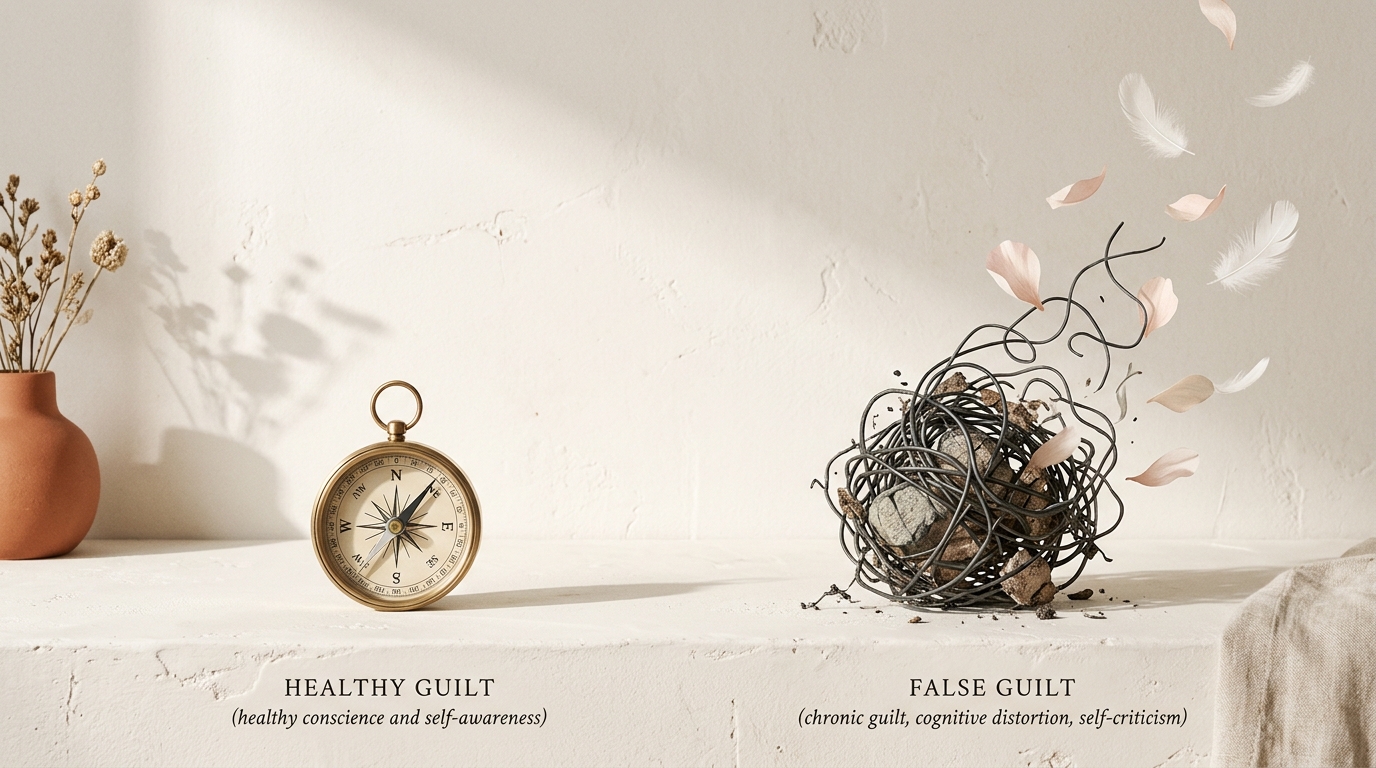
False guilt (often called unwarranted guilt, neurotic guilt, or phantom guilt in clinical literature) is a malfunctioning smoke detector. It goes off when you boil water or turn on the shower.
There is no fire. There is no moral crime. But the siren in your chest won’t stop screeching.
In his foundational book, Why Do I Feel Guilty When I’ve Done Nothing Wrong? (1993), clinical psychologist Dr. Ty C. Colbert points out that millions of conscientious individuals live in a state of chronic, unearned self-blame. They mistake the feeling of guilt for objective evidence of wrongdoing.
Your brain uses circular logic: “Because I feel terrible, I must have done something terrible.” In cognitive psychology, this cognitive distortion is known as emotional reasoning. But emotions are physiological reactions, not legal verdicts.
The Neuroscience: Deontological vs. Altruistic Guilt
Recent neuropsychological research gives us an even sharper lens into why our brains torture us this way.
Groundbreaking neuroimaging and clinical research led by Dr. Francesco Mancini and Dr. Barbara Basile (Neuropsychologia, 2011; Journal of Psychopathology, 2013) demonstrated that human beings experience two fundamentally distinct forms of guilt that activate different regions in the brain:
- Deontological Guilt (Duty-Based Guilt): Triggered when you believe you have violated an internalized rule, taboo, or standard of conduct—even if no one was hurt. Brain imaging shows this form of guilt strongly activates the insula, the brain structure that processes visceral disgust and bodily intuition. When you break an arbitrary internal rule (like “I must always say yes to requests”), your brain literally experiences a visceral spasm of moral self-disgust.
- Altruistic Guilt (Empathy-Based Guilt): Triggered when you perceive that someone else is experiencing distress, suffering, or disadvantage, and you mistakenly believe it is your job to relieve it. This form activates brain networks dedicated to Theory of Mind (ToM) and emotional empathy. When your friend is in a bad mood, your altruistic guilt triggers: “They are hurting, so my joy or my boundary is a form of betrayal.”
| Feature | Healthy / Functional Guilt | False / Chronic Guilt |
|---|---|---|
| Trigger | A genuine, identifiable violation of ethics or harm to someone | Setting a boundary, resting, or someone else’s bad mood |
| Focus | Specific behavior (“I said something unkind”) | Identity & worth (“I am inherently a burden”) |
| Physical Sensation | Temporary, targeted prick of conscience | Heavy, persistent knot in the chest, throat, or stomach |
| Resolution | Apologizing, making direct restitution, learning | Endless rumination, over-explaining, compulsive appeasement |
| Brain Pattern | Constructive social repair | Overactive insula & hyper-vigilant threat processing |
Understanding this difference is liberating: Having an overactive guilt response does not mean you are a bad person; it usually means you have an overdeveloped capacity for empathy with underdeveloped emotional boundaries.
Why You Feel Guilty: The 4 Hidden Psychological Roots
If you haven’t done anything wrong, where is this relentless self-blame coming from? It almost always traces back to four psychological mechanisms:
1. Childhood Conditioning and Emotional Parentification
Many adults who wrestle with chronic guilt grew up in homes where love, safety, or peace was conditional. Perhaps you had a parent who gave you the silent treatment when they were upset, or a household where conflict was volatile.
In trauma and relational psychology, when a child is forced to emotionally regulate their parents or walk on eggshells, this is known as emotional parentification.
As psychotherapist Pete Walker explains in Complex PTSD: From Surviving to Thriving, children frequently develop a fawn response—a survival mechanism where safety is achieved by preemptively pleasing others, anticipating their moods, and accepting blame just to keep the environment calm. As an adult, whenever someone around you is quiet, stressed, or disappointed, your childhood alarm system assumes you are in danger unless you take responsibility.
2. Conflating “Disappointment” with “Harm”
This is one of the most common blind spots for sensitive people: someone else being disappointed does not mean you harmed them.
If your coworker asks you to take on their project on Friday evening, and you decline because you have plans with your family, your coworker might feel disappointed. That is a normal, mild friction of human life. You did not insult them, deceive them, or take anything from them.
As we discussed in our guide on How to Say No at Work Without Damaging Relationships, when you treat other people’s mild disappointment as if it were a catastrophic injury, you disempower both yourself and them. Adults are fully capable of navigating everyday disappointments.
3. Hyper-Responsibility as an Illusion of Control
Psychologist Dr. Guy Winch, author of Emotional First Aid (2013), points out a fascinating unconscious motive behind unearned guilt: it gives us a false illusion of control.
Admitting that you cannot control whether your boss is grumpy, whether a client is unreasonable, or whether a loved one is struggling makes you feel helpless. Helplessness is terrifying.
To avoid the vulnerability of helplessness, your unconscious mind adopts hyper-responsibility: “If it’s my fault, then I can fix it by working harder, apologizing more, or being perfect.” Guilt, strange as it sounds, feels safer than powerlessness.
4. The Reflex to Over-Explain and Pacify
When false guilt strikes, our behavioral impulse is almost always to pacify. We launch into lengthy justifications or flood people with unnecessary apologies.
As explored in our deep-dive on How to Stop Over-Explaining Yourself at Work, scrambling to over-justify your boundaries sends a subtle signal to your own subconscious that you must have done something wrong. The very act of over-apologizing keeps the cycle of guilt alive.
5 Practical Ways to Stop Feeling Guilty When You’ve Done Nothing Wrong
Freeing yourself from phantom guilt does not happen overnight. It requires retraining your nervous system to tolerate the feeling without immediately reacting to it. Here are five practical, evidence-based practices:

Practice 1: Run the “Courtroom Reality Check”
Whenever that familiar surge of guilt hits your chest, mentally convene a courtroom trial. Imagine you are standing before an impartial judge and jury.
Ask yourself these three objective questions:
- What specific moral code, legal contract, or ethical commitment did I break?
- If my best friend did the exact same thing in my exact situation, would I convict them of being a selfish or bad person?
- Is there tangible, factual evidence that I caused harm, or am I treating my anxious thoughts as reality?
If you cannot name a concrete violation of your values, the verdict is in: You are experiencing false guilt. The case is dismissed.
Say silently to yourself: “My nervous system is sounding an alarm, but there is no fire. I am allowed to feel this sensation without accepting the blame.”
Practice 2: Establish the “Sphere of Emotional Sovereignty”
Draw an imaginary line between your skin and the rest of the world.
- Inside your circle: Your intentions, your words, your ethics, and your self-care.
- Outside your circle: How another person chooses to interpret your words, their mood, their unprocessed triggers, and their emotional reactions.
You are 100% responsible for being clear, considerate, and honest. You are 0% responsible for the emotional digestion of another capable adult.
When someone sighs, rolls their eyes, or acts cold because you expressed a limit, remind yourself: “Their feeling belongs to them. It is not my job to rescue them from their own emotions.”
Practice 3: Ride the 15-Minute “Guilt Surge” (Urge Surfing)
When you say no or honor a boundary, false guilt typically spikes within the first three to five minutes. This is when the urge to send a follow-up text (“Hey, are you mad at me? I’m so sorry!”) is almost irresistible.
In Dialectical Behavior Therapy (DBT), psychologists use a technique called urge surfing.
Instead of trying to extinguish the feeling by apologizing or making concessions:
- Sit in a comfortable chair and place both feet flat on the floor.
- Put one hand on your belly and take three slow, resonant breaths (inhale for 4 seconds, exhale for 6 seconds).
- Name the sensation without judgment: “My chest feels tight. My jaw is clenched. My body thinks I am in danger because I chose myself.”
- Set a timer for 15 minutes. Promise yourself you will not send a text, clarify your boundary, or apologize until the timer rings.
Ninety percent of the time, physiological emotional surges crest and subside within 10 to 15 minutes if you do not feed them with rumination. The more times you endure this wave without capitulating, the more your nervous system learns that setting a boundary will not kill you.
Practice 4: Apply Dr. Kristin Neff’s 3-Step Self-Compassion Protocol
In her landmark clinical research at the University of Texas at Austin, Dr. Kristin Neff, author of Self-Compassion: The Proven Power of Being Kind to Yourself (2011), proved that self-compassion is drastically more effective than self-criticism in reducing anxiety and chronic guilt.
The next time you catch your inner critic berating you for resting or declining an invite, apply Neff’s three core components:
The 3-Step Self-Compassion Shift:
1. Mindfulness: “This is a moment of discomfort and guilt.”
Acknowledge the physical tension and emotional sensation without exaggerating or suppressing it.2. Common Humanity: “Millions of kind, thoughtful people struggle with saying no. I am not uniquely broken.”
Remind yourself that wrestling with boundaries is a natural part of the shared human experience.3. Self-Kindness: “May I give myself the same patience, warmth, and grace I would give a dear friend today.”
Speak to your inner dialogue with soothing, supportive language rather than criticism.
Research shows that shifting from self-interrogation to self-compassion lowers cortisol levels and activates the parasympathetic (rest-and-digest) branch of your nervous system.
Practice 5: Replace Reflexive Apologies with Neutral Gratitude
People plagued by unearned guilt say “I’m sorry” as a conversational reflex.
You apologize when someone bumps into you in the hallway. You apologize when asking a waiter for water. You apologize when taking three hours to reply to an email. Every time you say “I’m sorry” for existing, your brain registers: “I must be at fault.”
Audit your speech and practice substituting reflexive apologies with neutral statements or gratitude:
| Reflexive Guilt Phrase | Grounded, Confident Alternative |
|---|---|
| “I’m so sorry for taking so long to reply!” | “Thank you for your patience while I was away from my desk.” |
| “I’m sorry to bother you with a quick question…” | “Do you have two minutes to look at this with me?” |
| “Sorry, I can’t make it, I feel so bad!” | “I won’t be able to make it this time, but thank you so much for the invite!” |
| “I’m sorry, I have a conflicting appointment.” | “I have another commitment at that time, but let’s connect next week.” |
Notice how the alternative phrases remain warm, polite, and respectful—without conceding imaginary wrongdoing.
Recommended Books & Research for Further Reading
If you want to dig deeper into the science of unearned guilt, boundary setting, and self-compassion, these works are essential reading:
- Dr. Ty C. Colbert – Why Do I Feel Guilty When I’ve Done Nothing Wrong? (1993): A classic, compassionate guide distinguishing true moral conscience from irrational childhood programming.
- Dr. Guy Winch – Emotional First Aid: Healing Rejection, Guilt, Failure, and Other Everyday Hurts (Plume, 2013): Practical psychological bandages for resolving unearned and lingering guilt.
- Dr. Kristin Neff – Self-Compassion: The Proven Power of Being Kind to Yourself (William Morrow, 2011): Foundational empirical research showing why self-kindness disarms chronic guilt.
- Pete Walker – Complex PTSD: From Surviving to Thriving (2013): Essential reading on the fawn response, hyper-vigilance, and why people-pleasing feels like emotional survival.
- Francesco Mancini & Barbara Basile – “Deontological and Altruistic Guilt: Two Separate Emotional Pathways” (Neuropsychologia, 2011): Pioneering neuroscience study illustrating the distinct brain mechanisms behind moral rules versus empathetic distress.
Frequently Asked Questions (FAQ)
Why do I feel guilty for resting or doing nothing?
Feeling guilty while resting is commonly known as productivity guilt. In achievement-oriented cultures, we are conditioned to equate our human worth with tangible output. If you grew up with the unspoken belief that you must “earn” relaxation, stillness triggers anxiety. Remind yourself that rest is a biological necessity, not an earned reward.
Is feeling guilty for no reason a symptom of anxiety or OCD?
Yes. Chronic, persistent guilt without an identifiable transgression is a recognized feature of generalized anxiety disorder (GAD), depression, and Obsessive-Compulsive Disorder (especially Moral Scrupulosity OCD). In OCD, individuals suffer from an overactive sense of deontological responsibility, obsessing over whether they have accidentally caused harm or violated a moral rule. If these thoughts feel intrusive or unmanageable, an evaluation with a therapist trained in CBT or ERP (Exposure and Response Prevention) can be life-changing.
How do I stop feeling guilty after saying “no”?
Remember that a boundary is not an attack; it is an honest statement of what you can sustainably give. When you say yes out of fear or guilt, you often end up resentful and burned out. Accept that feeling a 15-minute pang of guilt is the normal price of admission for protecting your long-term mental health.
What is the difference between guilt and shame?
As research professor Dr. Brené Brown famously delineated: Guilt is “I did something bad” (behavior-focused), whereas Shame is “I am bad” (identity-focused). Healthy guilt motivates constructive repair. False guilt, however, quickly morphs into toxic shame, convincing you that having human limitations makes you intrinsically unworthy or flawed.
Final Thoughts: Give Yourself Permission to Be Human
You do not exist on this earth to maintain the emotional equilibrium of everyone around you.
You are allowed to have limited energy. You are allowed to say no without writing an essay of excuses. You are allowed to take up space, eat a meal in peace, turn off your notifications, and let someone else be momentarily unhappy without rushing to fix it.
The next time unearned guilt knocks on your door, you do not have to invite it in for dinner. Acknowledge it gently: “I hear you, alarm. But there is no fire here today.”
Then take a deep breath, drop your shoulders, and return to the quiet peace of your own life.
Explore related reflections on the blog:
Harish Mehar
Founder & Lead Writer
Harish Mehar is the founder and writer of Reads Mind. As an avid reader of behavioral psychology, neuroscience, and personal growth literature, he synthesizes key concepts from books and real-world trials into grounded, actionable essays on assertive communication, personal boundaries, and everyday mental clarity.
Related Guides & Reflections

Feeling Behind in Life at 25: Why Your Unseen Years Were Not Wasted
Struggling with feeling behind in life at 25? Here is why your years of searching weren't wasted time, and how to start building self-trust today.

How Money Is Actually Earned: The Real Mechanics of Value, Leverage, and Earning Power
Why effort alone does not produce wealth, and what actually drives earning power. A clear, foundational guide to how economic value is created, captured, and scaled.

How to Restart Your Life From Zero: What Actually Works When Everything Falls Apart
When your career, money, or relationships collapse, generic self-help feels like an insult. Here is an honest, book-grounded guide to rebuilding your life from the ground up.