
Spatial Memory Techniques for Studying: How to Remember Complex Ideas Without Flashcards
Digital flashcards work for vocabulary, but fail for complex systems. Learn how to use ancient spatial memory techniques and desk maps to remember anything you study.
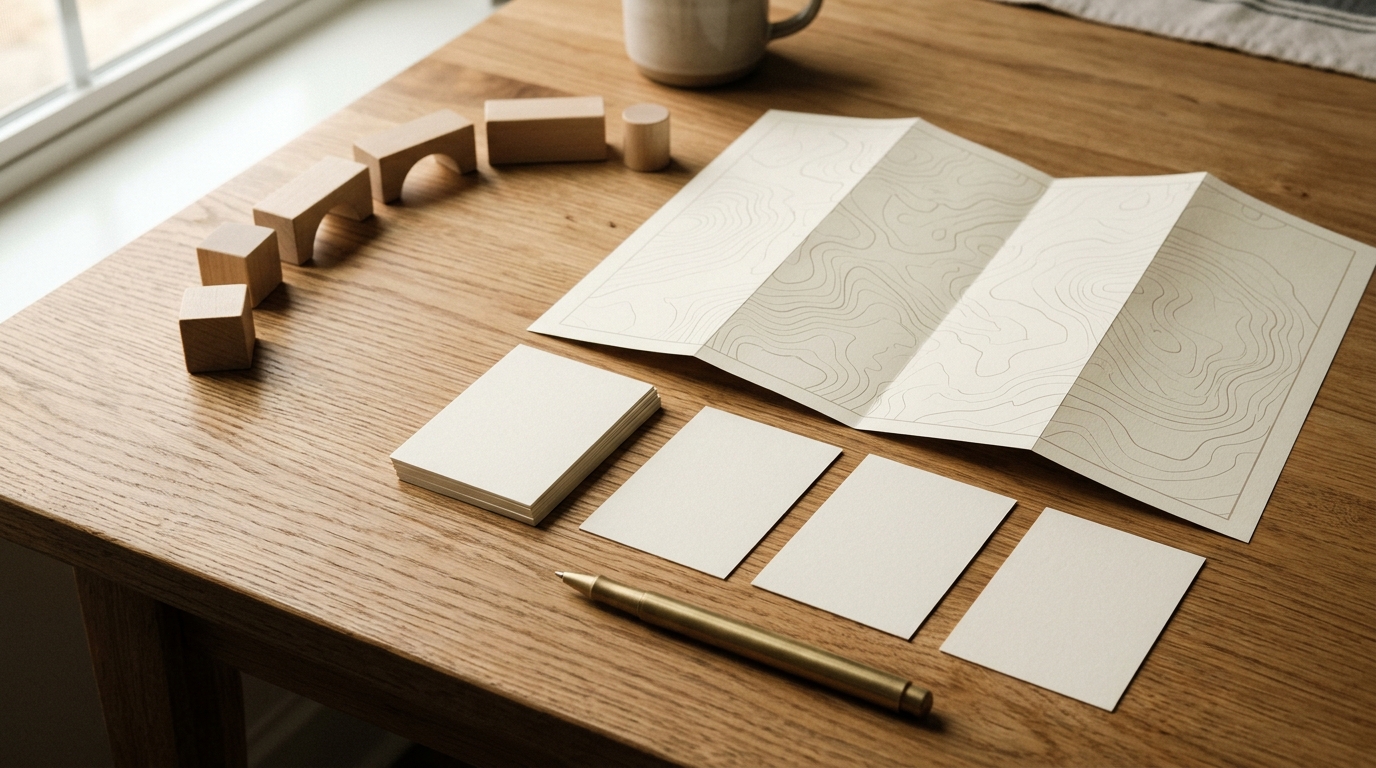
Table of Contents10 sections
- Why Your Brain Remembers Places Better Than Pages
- 3 Practical Spatial Memory Techniques You Can Use Today
- 1. The 5-Station Desk Map (Best for Books & Complex Topics)
- 2. The Room Walk (Best for Processes & Speeches)
- 3. The Physical “Lukasa” Memory Board (Best for Long-Term Projects)
- Combining Spatial Memory With Active Recall
- Frequently Asked Questions
- What is spatial memory in studying?
- When should I use spatial memory instead of flashcards?
- Do I need a giant building to build a memory palace?
Digital flashcard apps are great when you need to memorize 500 Spanish verbs or medical terms. But the moment you try to learn a connected system—like how an economy works, the architecture of a software app, or a 10-part presentation—flat flashcards fall apart. You end up memorizing isolated fragments while losing the big picture.
To fix that, you can borrow a technique humans used for thousands of years before paper notebooks existed: spatial memory. For the complete accelerated-learning system, see our main guide on how to learn anything 10x faster.
Why Your Brain Remembers Places Better Than Pages
Think about your childhood home or the grocery store you visit every week. Without studying a single flashcard, you can close your eyes and walk through every room, knowing where the fridge, the light switches, and the cereal aisle sit.
There is a biological reason for this. Your hippocampus—the brain region that turns short-term experiences into long-term memories—evolved primarily for spatial navigation and survival in physical environments. It was never designed to stare at flat black text on a glowing screen.
In her book Memory Craft, researcher Lynne Kelly studied how indigenous and ancient oral cultures memorized vast encyclopedias of navigation, astronomy, law, and biology without written language. Their secret was simple: they tied abstract knowledge to physical locations, objects, and paths.
3 Practical Spatial Memory Techniques You Can Use Today
You do not need to be a memory champion to use spatial encoding. Start with these three simple methods.
1. The 5-Station Desk Map (Best for Books & Complex Topics)
Instead of writing a three-page summary of a book or lecture, clear your desk and place five physical objects or blank index cards in a curved path from left to right.
- Assign one core concept to each station.
- Touch the first object and explain that concept out loud in plain language.
- Move your hand to the second object, explain how it connects to the first, and continue down the line.
Because your eyes, hands, and voice are all engaged in a physical sequence, your brain stores the structure of the whole topic as one connected map.
2. The Room Walk (Best for Processes & Speeches)
Pick a familiar room—your kitchen or bedroom—and choose 6 to 8 obvious landmarks in clockwise order (door, coat hook, desk lamp, window, bookshelf, chair).
Place one step of a process or one point of a talk at each landmark using a vivid mental picture. When you need to recall the sequence later, mentally walk through the room clockwise. You will rarely skip a step because the room’s layout holds the order for you.
3. The Physical “Lukasa” Memory Board (Best for Long-Term Projects)
Inspired by the Luba people’s handheld lukasa memory boards documented in Memory Craft, you can use a simple corkboard or single sheet of heavy paper as a permanent visual anchor for a big subject.
Draw simple icons, stick small colored pins, or group index cards by territory—left side for foundations, center for core mechanics, right side for edge cases. Every time you glance at the board, your spatial memory reinforces the whole system in seconds.
Combining Spatial Memory With Active Recall
Spatial maps work best when paired with retrieval practice rather than passive reading (see why rereading notes does not work).
- Build the map once after finishing a chapter or module.
- Walk the map from memory the next morning without looking at your notes.
- Patch only the blank stations where you forgot what belonged there.
Once you stop forcing your brain to memorize flat lists and start giving it places, paths, and physical anchors, complex subjects stick with a fraction of the usual effort.
Frequently Asked Questions
What is spatial memory in studying?
Spatial memory is your brain’s built-in ability to remember physical locations and paths. Attaching study concepts to real places or objects uses your hippocampus the way it naturally evolved to work.
When should I use spatial memory instead of flashcards?
Use flashcards for isolated facts like vocabulary. Use spatial memory whenever order, structure, or relationships between multiple ideas matter.
Do I need a giant building to build a memory palace?
No. Your bedroom, your morning walk, or five objects arranged on your desk work just as well because you already know their layout effortlessly.
Harish Mehar
Founder & Lead Writer
Harish Mehar is the founder and writer of Reads Mind. As an avid reader of behavioral psychology, neuroscience, and personal growth literature, he synthesizes key concepts from books and real-world trials into grounded, actionable essays on assertive communication, personal boundaries, and everyday mental clarity.
Related Guides & Reflections

Feeling Behind in Life at 25: Why Your Unseen Years Were Not Wasted
Struggling with feeling behind in life at 25? Here is why your years of searching weren't wasted time, and how to start building self-trust today.

How Money Is Actually Earned: The Real Mechanics of Value, Leverage, and Earning Power
Why effort alone does not produce wealth, and what actually drives earning power. A clear, foundational guide to how economic value is created, captured, and scaled.
How to Learn a New Skill in 20 Hours: The Exact Blueprint From Zero to Competent
You do not need 10,000 hours to get good at a new skill. Here is the practical, step-by-step 20-hour blueprint to go from complete beginner to functional competence.